From the “American Dream” to AI-Enabled Aging, From Drug Innovation to Global Peace—What Signals Did We Miss?
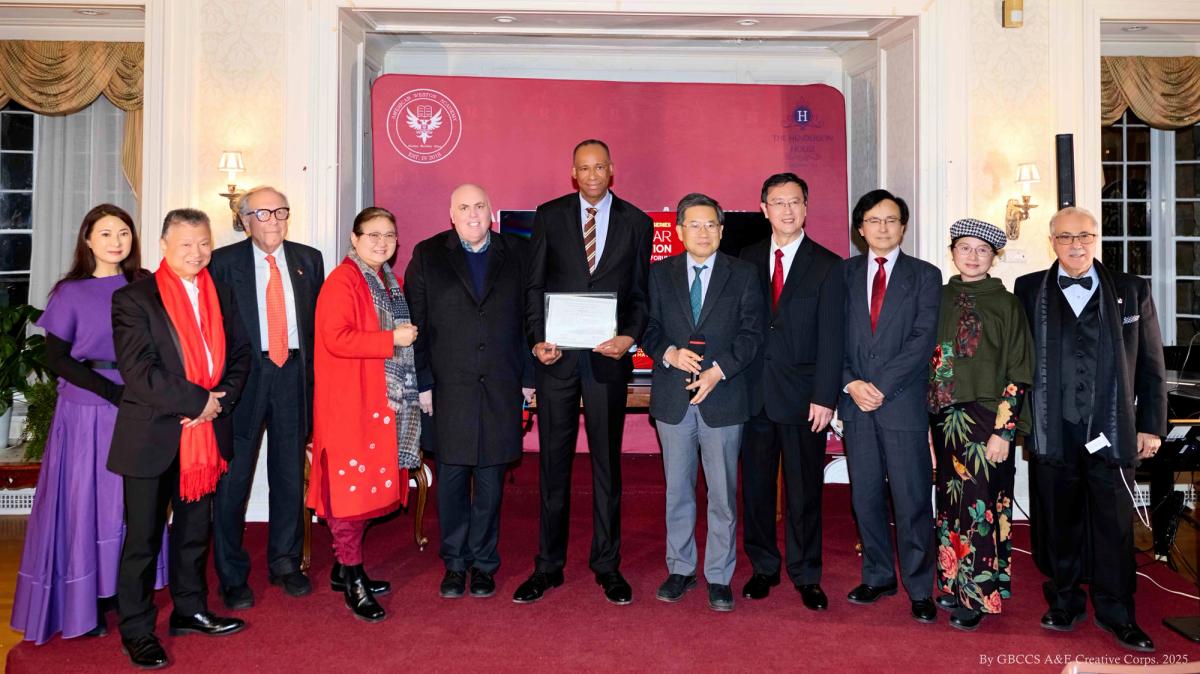
As 2025 drew to a close, the World Speakers Series convened in New York for a forum that brought together leaders from law, business, technology, medicine, investment, and international relations. Centered on the theme of Innovation · Collaboration · Shared Prosperity, the gathering offered more than inspiration—it surfaced patterns about how the future is being shaped across domains.
This was not a conference designed to produce consensus. It was a space for comparison: different life paths, different industries, and different geographies—examined side by side to understand what kind of leadership the next era demands.
Chapter One
From Personal Struggle to Structural Opportunity
Several speakers began not with theory, but with lived experience—stories that traced how individual trajectories intersect with broader economic systems.
John Lam’s journey is emblematic. Arriving in New York from Hong Kong in 1969 with twenty dollars, he began as a dishwasher before entering garment manufacturing. Within six months, he and his sister launched their own business, generating their first six-figure revenue. His later decision to repurchase his former employer’s factory—at a premium, out of gratitude—eventually resulted in a company producing over $100 million annually, including innovations such as washable silk.
Lam’s career later expanded into real estate, banking, and hospitality. Notably, he exited half his assets before the 1987 market crash and built a hotel management company that ranked among the top 25 in the U.S. before a successful $65 million exit. Across sectors, his principle remained consistent: sustained success comes from understanding customer needs and continuously reinventing value.
Joseph Cirnigliaro’s path underscored a different dimension of globalization. Born in Sicily and raised in New York’s Chinatown, fluent in Cantonese, and educated at Columbia University, his career spanned entertainment, gaming, and political marketing—including serving as marketing director for Donald Trump’s presidential campaign.
For Cirnigliaro, cultural fluency was not an accessory but a strategic asset. Integrity and execution, he argued, are what allow multicultural experience to translate into durable influence.
The shared lesson was understated but clear: global perspective is rarely inherited. It is built through friction.
Chapter Two
Technology, Medicine, and the Architecture of Future Health
If the first chapter focused on human agency, the second examined how science and technology are reshaping the boundaries of health and longevity.
Life sciences researcher Shawn Du, PhD, argued that the next decade of medical progress will exceed that of the past century. He highlighted innovations such as the Inlexo bladder cancer treatment system—a localized, slow-release chemotherapy device designed to improve efficacy while minimizing systemic toxicity.
Equally significant, Du emphasized AI’s growing role in drug discovery and clinical trials. By automating patient matching and trial design, AI has already shortened development timelines by roughly two years and reduced costs by tens of millions of dollars. The implication is not faster science alone, but more economically viable innovation.
In oncology, Mark Kirschbaum, MD, described a paradigm shift in leukemia treatment. Traditional intensive chemotherapy has long been poorly tolerated by older patients. New combination therapies—pairing azacitidine with the BCL-2 inhibitor venetoclax—now achieve remission rates approaching 90%, delivered orally at home without hospitalization. These therapies are no longer age-specific alternatives; they are becoming the new standard of care.
Kirschbaum framed the shift with a metaphor: cancer cells are less an enemy to be destroyed than a system gone out of control. The goal is not annihilation, but restoration of balance.
Helen Hsu, MD, extended this logic upstream. Her approach to longevity emphasizes prevention over intervention, grounded in six pillars: exercise, nutrition, stress management, genetics, sleep, and social connection. She argued that future medicine must become predictive and personalized—leveraging genomics, biomarkers, and continuous assessment to act before disease manifests.
Beginning in 2026, Hsu plans to launch programs integrating Western precision medicine with elements of traditional Chinese practice, including acupuncture and herbal therapies—an attempt to operationalize truly integrative care.
Technology’s role in aging was further illustrated by Greg Lakis, founder of Lincoln IT. His AI companion system, “Myla,” is already deployed in senior living communities. Designed for conversation, memory continuity, and fall-risk monitoring through wearables, Myla also enables virtual travel experiences that reduce loneliness, anxiety, and depression.
Lakis summarized the philosophy succinctly: technology’s value lies not in complexity, but in care.
From an investment perspective, venture capitalist Caleb Simmons framed capital itself as a multiplier. Each high-tech job, he noted, generates five to eight additional jobs in the local service economy. In deep tech sectors—AI, quantum computing, cybersecurity—approximately 85% of patents originate from venture-backed companies. Capital, in this view, does not merely fund innovation; it shapes the economic structures that follow.
Chapter Three
Global Responsibility: Peace, Cooperation, and Long-Term Stability
The final chapter widened the lens from markets and medicine to humanity’s shared risks.
Gloria Liya Rong, founder of Boston International Business School, described her institution’s mission as training leaders capable of operating across systems—business, AI, computer science, and even film and art. Since its founding in 2018, BIBS has pursued a deliberately interdisciplinary model. In 2026, the school plans to establish a permanent New York presence to deepen dialogue between executives and experts across fields.
Peace advocate Sally Johns offered a stark counterpoint to technological optimism. There are currently more than 12,000 nuclear warheads worldwide, with nearly 4,000 on high alert. A single detonation over a major city could kill over one million people. Representing Peace Action, Johns called for three concrete steps: de-escalation of nuclear readiness, commitments to no-first-use, and ratification of the Treaty on the Prohibition of Nuclear Weapons.
Her message was direct: peace is not idealism. It is a condition for survival.
Michael Daly, a five-time Nobel Peace Prize nominee, approached the issue from an economic angle. “Where there is good business,” he argued, “there is no war.” Fair trade, in his view, is the smallest unit of peace, while prosperity is conflict’s most reliable antidote.
Discussing U.S.–China relations, Daly noted structural complementarities: China’s Belt and Road Initiative expands markets and absorbs capacity, while the U.S. maintains strengths in innovation and advanced manufacturing. AI, by lowering the barrier to entrepreneurship, enables individuals and small teams to contribute to global solutions at unprecedented scale.
His lifelong mission, he said, is to remove the economic roots of war through sustainable development and equitable exchange.
Conclusion
The Power of Ideas Is Already at Work
The World Speakers Series did not attempt to resolve humanity’s biggest challenges. Instead, it clarified what is at stake.
- A single insight can redirect an industry.
- A medical breakthrough can extend millions of lives.
- A rational conversation can prevent irreversible harm.
The world does not lack problems. It lacks leaders willing to combine responsibility with imagination—and cooperation with action.
The next World Speakers Series will take place on January 22, 2026. For those watching closely, the most important signals may not come from consensus, but from the tensions leaders are willing to confront together.
Source: original Chinese forum recap and materials.